Tuesday, April 12, 2016

PAUL ONDITI AT THE ART SPACE


HELTER-SKELTER ONDITI’S LATEST EPISODE OF SMOKEY’S TRAVELS


By margaretta wa Gacheru 12.2015
(This story appeared in hard copy in Business Daily late in 2015 but was never put online. So I'm taking this opportunity to share it with those interested.
Paul Onditi's portrait by Dale Webster hung next to Gor Soudan's at Red Hill Gallery's recent 2016


One of the first things Paul Onditi did after getting back from living in Germany for nearly a decade was to introduce us to his imaginary best friend who he’s named Smokey.

That was back in 2012 when nobody knew we’d still be getting to know Smokey up to now when Onditi is having a solo exhibition entitled ‘Helter-Skelter’ throughout December at Wambui Kamiru’s new Art Space in Westlands.


In fact, Smokey and Onditi’s unusual techniques of creating multimedia art have invariably been the key eye-catching aspects of all the artist’s exhibitions, be they group or solo.

Onditi’s current show (which fills two floors of The Art Space) once again stars Smokey as the central subject of his enigmatic showcase. Smokey is just as intriguing as ever despite the fact that Onditi only shows us the backside of his intrepid friend. Apparently that’s because Smokey is ever on the move, and our role as observers is to let him take the lead as he blazes trails into uncharted territories.

It’s as if he’s an adventurous explorer who can travel anywhere or just as far as the artist’s imagination will take him. And while Onditi insists Smokey is nothing like his ‘alter ego’, he also claims Smokey is just like “you, me, anybody and everyone”, implying he is just an ordinary guy.

But just as the artist is not an ordinary guy, neither is Smokey, a character who we’ve seen grow and change and get ever-more adventurous since he first appeared on the local arts scene at Onditi’s first exhibition at Alliance Francaise.

For when he first arrived, Smokey seemed somewhat alienated, a solitary soul stepping out into a wild and wooly world. Back then, much of Onditi’s paintings were filled with various shades of grays, black and shadowy white.

But however drab seemed his colors, the artist himself was obviously in an experimental mode, fueled by curiosity as he crafted his art on metallic pieces of paper with the main subject being the early adventures of Smokey  which Onditi etched out using tools other than ordinary brushes and palette knives.

But Smokey and his maker have traveled very far since then. He’s still on the move, on a journey to who knows where.

At his recent opening (December 10th), the artist was asked what was Smokey’s final destination? Onditi clearly enjoyed keeping his audience guessing.

“If Smokey discloses that [place], his story will be over, his journey will be done, the mystery will be gone and he’ll have no more reason to exist, which is why I don’t outline where he’s going next,” said Onditi.

What’s clear about his Helter Skelter show is that Smokey has traveled many places, most of which are no longer conveyed in shades of gray. Instead, his use of color is now vibrant and varied, but it is only one aspect of his art which is multi-layers as well as multi-media.

For an artist, Onditi is most generous about explaining how his concepts, materials and  techniques work together to create ‘paintings’ that might look like collage but are a whole lot more complex. For while all his current works are created either on paper or plastic polythene, Onditi combines paint, pencil and printer’s ink placed on his flat sheet using a ‘photocopy transfer’ technique.

After that, Smokey gets situated in various mindscapes that feel more like visual streams of consciousness since he often seems to be walking in groundless space, as if defiant of laws of gravity and other earthly constraints.

Ultimately, Onditi seems to enjoy the enigmatic and ambiguous since just as Smokey’s destination is undefined, so the places and spaces through which he journeys seem to be encrypted in a visual language that only the artist understands.

Not that Onditi’s ‘paintings’ are abstract since Smokey is always there on route to who-knows-where. One can simply call them semi-abstract and conceptual since the artist clearly knows what he’s up to as he transfers all sorts of specially selected photocopied images, which he often paints over to accentuate specific points of interest.

Ultimately, it may well be that the title of Onditi’s show, Helter Skelter, explains the gist of his exhibition which is that while Smokey [and the artist] are still very much on the move, they haven’t yet settled; they are still trekking (helter-skelter, here and there) and they plan to be doing so for quite some time to come.


Monday, April 11, 2016

ELIMO NJAU CARRIED A CROSS ON EASTER SUNDAY

PAA YA PAA GALLERIST AND ARTIST ELIMO NJAU HAS BEEN CARRYING A HEAVY BURDEN IN THE LAST FEW MONTHS

By Margaretta wa Gacheru

Easter 2016

Elimo Njau in a ceremonial role, carrying the cross reminiscent of what Jesus Christ had to endure before his resurrection and ascension

When the Ridgeways Baptist church invited their neighbor Elimo Njau, co-founder and current managing director of Paa ya Paa Art Centre, to carry a cross as part of their Easter Sunday service recently, they had no idea how meaningful such an event would be for this 84 year old artist who’s been a Christian all his life.

Easter services were conducted all over the country and quite a few must have had members of their congregations carrying a cross in remembrance of the sorrowful moments when Jesus had to walk to his own crucifixion carrying the instrument that would facilitate his torture and cruel demise.

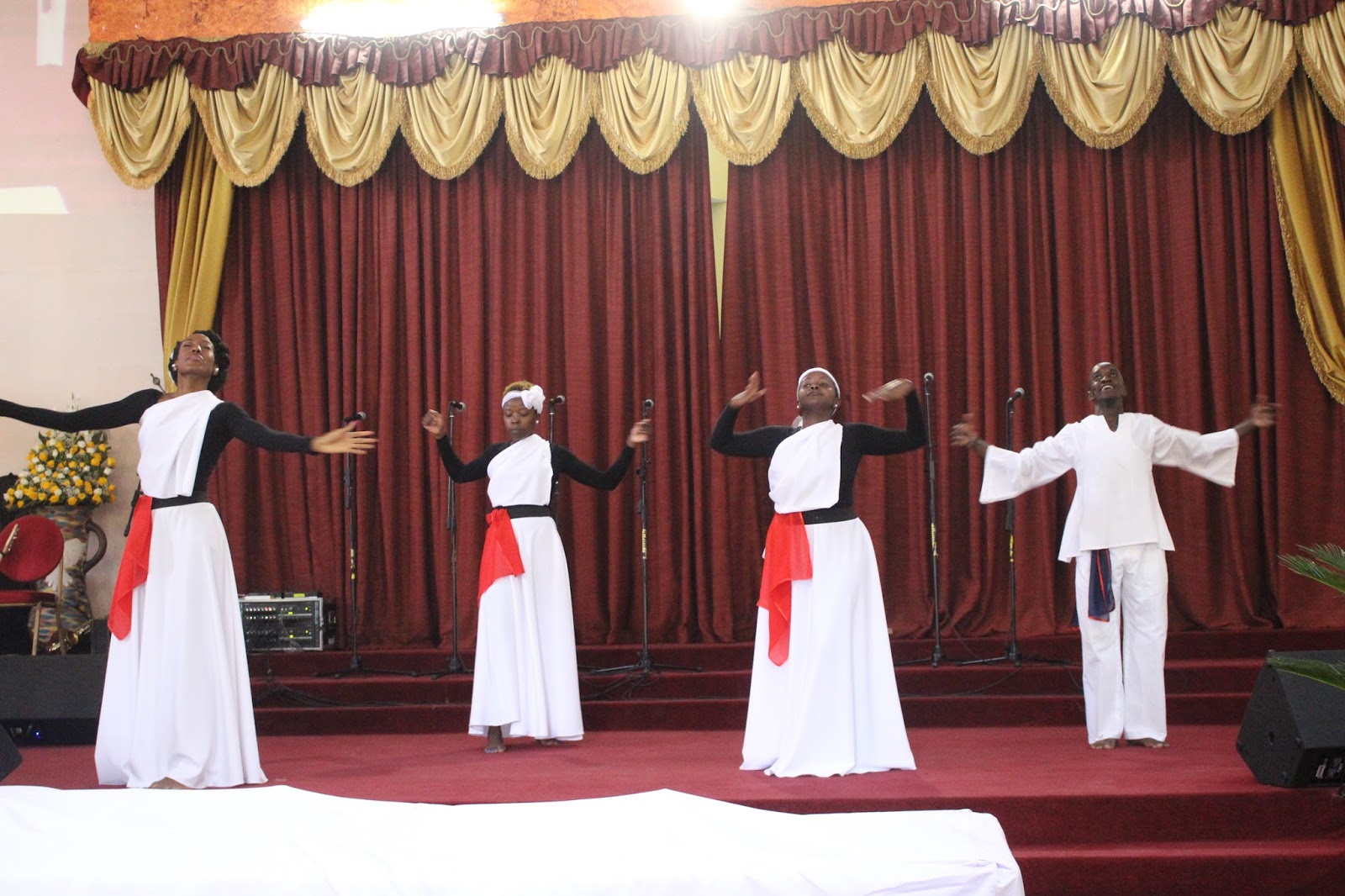
But I wonder how many services also celebrated the resurrection with an elegant contemporary dance, beautifully choreographed by Arthur Jude Maura who also accompanied three graceful women dancers, one of whom was the professional African American dancer Amber Anderson.


Some Christians might have disapproved on their dancing in Church but it was such a tasteful performance that even the most conservative Christians could have appreciated it.

In any case, the Baptists, like many New Age and mega-churches, bring a number of musical instruments (besides the traditional organ) with them when they come to evangelize in countries like Kenya.

On Easter Sunday, the Ridgeways Baptists had three keyboards accompanying their choir and congregation as well as the dancers who embodied the joyous experience that Christians celebrate at Easter, that of Jesus Christ’s resurrection from the grave.

Njau’s performance of carrying the cross preceded that of the dancers since the idea was to dramatize both the darkest and the brightest moments that culminated in Jesus’ resurrection.

The Easter message was especially significant to Elimo since he too has been carrying a heavy burden in the last few months, ever since people came and constructed a mabati (corrugated iron) fence across his land and claimed the acreage on the far side of the fence belonged to them.

According to Njau, the whole five acres were bought by his former secondary school English teacher, Maurice Wolfe back in the 1970s in Njau’s name but meant for the development of Kenyan contemporary art and artists. The fence was actually pulled down once by local artists but it was reconstructed without Njau’s or Wolfe’s permission.

Elimo's grandson assists his father Nikita to carry the cross


In any case, the 84 year old Njau was immensely consoled this Easter by the Christian message which is essentially that the darkest hour precedes the dawn of a new day of hope and divine possibilities.

Graffiti artists painted their concept of the Resurrection dawn on the corrugated iron fence on Elimo's side of the contested land

DALE WEBSTER: FROM PHILOSOPHER TO MASTERFUL PORTRAIT PAINTER

HOW DID DALE WEBSTER MORPH FROM BEING A PHILOSOPHER AND ART HISTORIAN TO BEING A MASTERFUL PORTRAIT PAINTER, A PAINTER OF PAINTERS?


By Margaretta wa Gacheru (April 2016) 

Despite his teaching philosophy for more than a decade both in UK and West Africa, and despite his dropping out of St. Martin’s School of Art after just a year, there’s little doubt that Dale Webster was destined to become a professional painter, even an artist’s artist.
(L-R) Mixed media artist Kamal Shah, painter Beatrice Wanjiku Njoroge and Shabu Mwangi painted by Dale

He’s taken his time getting round to what any good fortune teller could have foreseen back when he first went to one of UK’s best art schools back in the 1970s.
BBC Producer and the artist's wife Jackie Webster first met in West Yorkshire, UK  

But then he got intrigued with ideas and the theoretical gymnastics that philosophers go through. He studied fine art together with philosophy for several years at Leeds University and at University of California, Berkeley.
MASK Founder Alla, painter James Mbuthia and Sculptor Chelenge van Rampelberg all painted by Dale
But while he might have dabbled with painting during those years, once he got out on the job market, he identified as a philosopher and university lecturer.

It’s only been since he came to Kenya with his family nearly a decade ago that Dale stopped dabbling and began to take himself seriously as a painter.
A
           Kenyan artists and friends of the arts at Dale's second solo exhibition at Red Hill Gallery
His transformation from philosopher to full-time painter is a process that’s still underway. But if one can get to Red Hill Gallery and see his latest exhibition of portraits (which opened last Sunday), you’ll see that Dale was not only destined to be a painter; he also got here just in time to be part of what some have called a ‘renaissance’ in Kenyan art!
Kenyan artists (L-R) Peter Ngugi, Jackie Karuti and Richard Kimathi

Dale has been doing portraiture practically from the time he picked up a paint brush back in 2007 and had his first Nairobi exhibition at his daughters’ school.
 Kenyan artist Paul Onditi and Gor Soudan
“I found the diversity of people living in Nairobi fascinating,” he told Business Daily shortly before the opening of his current Red Hill show. It was that interest in the city’s wide variety of peoples that led to his having his first public exhibition at Le Rustique Restaurant in Westlands.
Kenyan Events Photographer Peter Kariuki

His subsequent exhibitions have taken place everywhere from the Ramona Museum, Le Rustique and Village Market to University of London’s School of Oriental and African Studies.
Kenyan artist and arts writer Zihan Kassm
But his shows at Red Hill are undoubtedly the ones most memorable and meaningful, first, because they feature familiar faces, fellow artists who may not be well known to the wider public but who are definitely members of the current community of Kenyan ‘creatives’ who are actively involved in expressing their own artistic initiatives.
The Art Space Gallerist Wambui Kamiru-Collymore with the brother of Jacke Webster and former philosophy student of Dale's
The other reason his Red Hill exhibitions are to my mind so significant is because of the historical context in which Kenyans are living through right now. For something creatively cathartic seems to be underway in the local art world. But there are few witnesses to this profound change in the local art scene who are documenting what’s going on. My view is that Dale is one of those few.
Painters Jimnah Kimani and Tom Mboya
In his first exhibition at Red Hill two years ago, he had already begun visually chronicling some of our most prominent Kenyan artists, starting with Peter Elungat, Michael Soi, Thom Ogonga, Maggie Otieno, Patrick Mukabi and Beatrice Wanjiku among others.
Painters Fitsum and Kamicha with American photographer Bruce

In this second Red Hill show, he continues on what seems to be a quest to visually capture even more Kenyan artists as well as friends of the arts who he’s gotten to know since that first exhibition.
Art Critic for The East African, Frank Whalley
That’s why he’s included everyone from Peterson Kamwathi, Paul Onditi, Gor Soudan and Chelenge van Rampelberg to Jackie Karuti, Jimnah Kimani, Wambui Kamiru, John Kamicha and Richard Kimathi just to name a few of the exceptional Kenyan artists whose portraits are up at Hellmuth and Erica Rossler-Musch’s gallery.


Erica Rossler-Musch with United States International University professor Dr. D. King

There are questions some critics may ask about the realism of every painting. For instance, James Mbuthia’s struck me as being too stoical compared to the jovial artist that I know. Wambui Kamiru’s portrait is beautiful but a bit too placid to serve as an accurate expression of The Art Space gallerist. But at the same time, Dale captured a hint of Paul Onditi’s ironic sense of humor in his portrait. And for me he’s spot on with his visualization of Zihan, Beatrice and Kamicha as well as many others.
Red Hill Gallerist Hellmuth Rossler-Musch has hosted Dale Webster's solo exhibition twice in the past two years

Some critics have suggested Dale’s usage of photographs makes his paintings one-dimensional, but I disagree. I feel he’s not the first exceptional artist to use photography as a part of the painting process. What’s more, it would seem it’s his first-hand knowledge of these artists that enables him to give nearly all his portraits a depth of feeling that goes beyond the superficial. One feels he tries to capture something more soulful about every artist that he chooses to paint.


Tuesday, April 5, 2016

TINGA TINGA TALES THE MUSICAL AT THE ELEPHANT


TINGA TINGA TALES: THE MUSICAL TRIUMPH

By margaretta wa Gacheru April 1--17, 2016

The only production that I’ve seen in Kenya that comes even close to the quality, creativity and  exceptional synthesis of music, dance, costuming, set design and even props of the brand new musical ‘Tinga Tinga Tales, the Musical’ is ‘Mo Faya’.

It’s obvious why this is the case: Eric Wainaina wrote the music for both productions; he also starred in both and his mate Sheba Hirst was the producer of both shows, the latter point explaining how last Friday night’s premier performance of the new musical came off without a hitch at The Elephant, the venue off James Gicheru Road in Lavington, best known for its Thursday night live music but nothing ever before on the scale of [Ms1] Tinga Tinga Tales (TTT).

There are huge differences between the two musicals however, largely because one was completely written by Eric and was set wholly in the present-day Nairobi, while Tinga Tinga Tales derives from the animated children’s TV series scripted by Claudia Lloyd and based on traditional African folktales.

The other big difference between the two shows is that Mo faya was directed by John Sibi Okumu whereas in TTT Claudia Lloyd directs and Sibi costars as the Lion King of the Tinga Tinga animal kingdom.

Yet in both cases, there’s an all-Kenyan cast who were compelled to sing, dance and in the case of Mo Faya, travel all the way to New York City where the show was staged off Broadway and to Europe where it wow-ed audiences in Switzerland.

There’s no telling where TTT will go, but certainly the storyline is charming as it draws upon several of the folktales that Ms Lloyd adapted for more than 50 episodes of the TTT animated TV series. They include the wonderful tales of how the giraffe got her long neck, how the chameleon acquired his camouflage and beautiful colors and even how the animal kingdom put together its own Festival of Colors.

But transforming cartoon animations into an enchanting musical for both children’s and adults’ happy consumption was quite a feat that couldn’t have been done without a collective effort that required expertise from everyone, including a choreographer like Mkamzee Mwatela, costume designer like Ann McCreath of Kiko Romeo, and of course Claudia Lloyd, all of whom were able to make us believe Sibi Okumu was a king, Eric a monkey, and even Iddi Achieng a hippopotamus.

Certainly all the children who came (and got to sit on the floor right in front of the colorful stage in what Sheba Hirst described just before the show began as the ‘best seats in the house’) had no problem believing Elsaphan Njora was a tortoise, Joshua Mwai an elephant and Phy a giraffe (even after she acquired her super-long neck).

They didn’t even have a problem believing the way Chameleon (Elton John Mwambi) was transformed from being gray and dull to acquiring a brand new suit, cape and even dreadlocks of rainbow colors. For it was all part of the enchantment that TTT managed to achieve.

But special praise has to go out to Eric Wainaina whose music was both masterful and a beautiful mix of many different genres, styles and sounds. He clearly worked closely with Claudia Lloyd to synchronize sound and script very well.

The band as well as the entire cast also deserves heaps of praise since they all performed like seasoned professionals.

But I can’t forget the set designers at Studio Propolis as well as the light and sound technicians from Homeboyz and Bankslave who painted the set beautifully with one giant bird-filled baobab tree. The lighting never interfered with the acting and the sound was also superlative as we could actually hear every syllable and song, whether the language was English or Kiswahili.

One can only hope that TTT: The Musical will go as far, if not farther than Mo Faya did. We need not draw parallels between TTT and The Lion King which also started as an animated film and then became a phenomenal musical and smash hit. It’s tempting to compare the two productions, especially as both aim to charm and enchant children and adults alike. But the future looks bright for Kenya’s newest musical that runs at the Elephant until April 17th from Wednesdays through Sundays at 3pm and 6pm.

Meanwhile, tonight through Sunday, FCA is staging ‘Secrets & Lies’ at Alliance Francaise and next Tuesday through Sunday, Heartstrings will stage its latest comedy ”Once Bitten Twice Shy’ also at AF.


 [Ms1]

Friday, March 4, 2016

PATRICK MUKABI: THE BABA SUPAA WHO BRINGS ART TO CHILDREN ON CITIZEN TV EVERY WEEK

Saturday Nation
Thursday, May 14, 2015
Patrick Mukabi: Master mentor and teacher finally has space to call his own
PATRICK MUKABI: GENEROUS MENTOR OF A MULTITUDE OF ASPIRING ARTISTS, BOTH YOUNG AND OLD

by margaretta wa Gacheru

 
Patrick Mukabi aka Papa Supaa (to those TV fans who watch him teach children about art regularly on Saturday mornings during the ‘Know Zone’ which is part of Makutano Junction on Citizen TV) had been sharing his studio space for years with countless up-and-coming young artists keen to rub shoulders and learn from the Master Mwalimu Mukabi.
Mukabi always had an open door policy at the GoDown Art Centre where he’d been a resident artist practically from the day the GoDown was born at the turn of the new millennium.
SPACE TO CALL HIS OWN
But the time came when Mukabi realised he needed studio space that was all his own. Not that his new ‘Dust Depo Art Studio,’ situated just next door to the old Railway Museum, isn’t still welcoming aspiring young Kenyan artists (and those from other countries as well, such as China, Holland, UK and USA).
It’s just that since April 1st when Mukabi fully and finally moved into the space that used to be known as the Railway Museum Art Studio, he’s now in charge of how his studio is run.
He had never planned to move into spaces related to the Railways but now that he’s in, Mukabi says he feels as if, in a way, he has ‘come home’.
That’s because his father was a top executive with Kenya Railways which meant some of Mukabi’s happiest times growing up were on trains traveling first class with his family as it was one sure way his father could have quality time with his son.
The real irony of his ‘coming back’ to railways turf is that even his grandfather Mukabi was an employee of the East African Railways.
 “He used to sleep in the back of the train since his work involved him traveling back and forth, from the Coast to Kampala and back,” Mukabi recalled.
A KENYAN CLASSIC
His grandfather also often took his family with him on his travels.
“Since my grandmother, my father’s mother, died when my dad was still a small boy, my grandfather would take him with him so my dad ended up learning nearly every language of the people who lived on or near the railway line,” he said.
Today, Patrick Mukabi is in a sense also doing as his father and grandfather had done. He too is bringing along young people, many of whom consider him their number one mentor (meaning more like a father), as they journey towards constructing a really strong contemporary Kenyan arts community.
Already, many of the young artists who’ve studied under him, youth like Nadia Wamunyu, Alex Mbevo and Dickson Kaloki, have gone on to make names for themselves as ‘emerging’ East African artists of merit.
Mukabi is definitely a Kenyan classic, a generous spirit and soulful mwalimu who’s recognised all over Kenya and beyond for the quality of his art.
They’re not surprised to hear that Mukabi also has a mentor, only that Michelangelo died several centuries back; but he’s still a key source of inspiration and serves as such a high standard of excellence that Mukabi humbly admits that he still has a lot to learn as a fine artist.  
Mukabi with some of his work at his studio.
Mukabi's new space and some of his pieces.
Patrick Mukabi with his new artwork. PHOTO|
Artwork by one of Mukabi's many protégés.
Artwork by one of Mukabi's protégés. PHOTO|
Artwork by one of Mukabi's many protégés at the
Artwork by one of Mukabi's protégés. PHOTO|
Thursday, May 14, 2015

Patrick Mukabi: Master mentor and teacher finally has space to call his own

Patrick Mukabi has had a long history with the
Mukabi with some of his artwork at his new
Mukabi with some of his work at his studio.
Mukabi's new space and some of his pieces.
Patrick Mukabi with his new artwork. PHOTO|
Artwork by one of Mukabi's many protégés.
Artwork by one of Mukabi's protégés. PHOTO|
Artwork by one of Mukabi's many protégés at the
Artwork by one of Mukabi's protégés. PHOTO|