Martin Otieno (1950 - 2014.6.April)
Kuona Trust just posted a thoughtful profile/obituary of our dear friend Martin Otieno. I
must share one point that i think could easily be forgotten, and that is that if it
hadnt have been for Martin, there might never have been a Manjano annual
art exhibition and competition. it was he, who spent a bit of time
walking the corridors of the ministry of culture, who knew of the
challenge facing late Agatha Ndambuki, the new Department of Culture
director. Agatha was given the docket to organize the Nairobi Provincial
Art Exhibition but found there had been no records kept, no
documentation and no one to give her guidelines on what to do next. she
didnt even have a computer or an email! So it was Martin who stepped in
and introduced her to The GoDown Art Centre and Joy Mboya and Judy
Ogana. They assisted Agatha immensely, first by linking her up with most
of the art centre directors around the city and a few media people and
scholars as well. That is how the first Manjano was born. There is no
telling what Agatha would have done without The GoDown's support. but
more importantly, no telling what she would have done without the
assistance of Martin, the wise, kind and thoughtful man who was also an
arts advocate and friend to many in the Kenyan art world.
Saturday, April 12, 2014

Thursday, April 10, 2014
NEW KENYAN FILM PREMIERS AT ALLIANCE FRANCAISE
Ni Kuruka Maisha, the doc feature film, reveals youth's leap of faith out of slum squalor
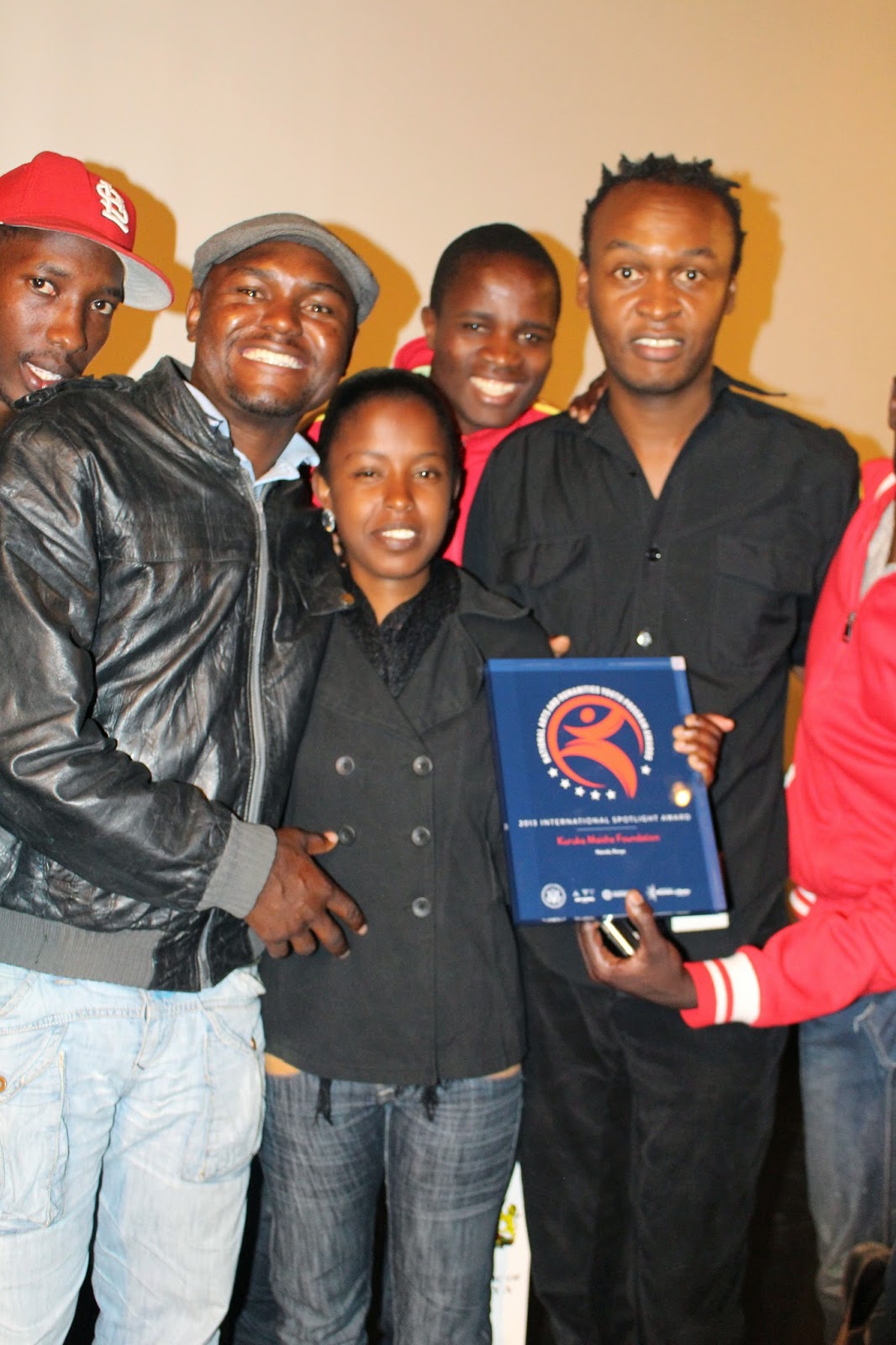 Kuruka Maisha graduates with director of film Ni Kuruka Maisha, Ehoodi Kichapa who also began his career as a painter while teaching at the GoDown-based project. pix by margaretta
 H.E. Belgian Ambassador Bart Ouvry with Kuruka Maisha founder/director Nick Balongo & film director Ehoodi Kichapa at the premier of Ni Kuruka Maisha
Story coming shortly
Story coming shortly
Wednesday, April 9, 2014
KENYA VISUAL ARTISTS NETWORK ELECTS NEW OFFICERS
ARTISTS
ELECTIONS A SUCCESS
By
Margaretta wa Gacheru
Kenya Visual
Artists Network held a successful national election late last month (March 29th)
at the Eureka High Rise Hotel.

New KVAN officers (l-r) King Dodge Secretary, Wakonyote Chairman, Kanini Rose Treasurer, Adrian Nduma Deputy Chair, and Pascal Nduma Deputy Sec'y. pix by margaretta
The officers
elected included Wakonyote Njuguna, Chairman (by a unanimous vote), Adrian
Nduma, Vice Chair, Secretary, King Dodge Kingoroti, Deputy Secretary, Pascal
Chuma and Treasurer, Rose Kanini.
The idea of
a Kenya Visual Artists Network initially came out of a European Union-funded
project developed prior to the 2013 national elections aimed at employing art
in the interests of good governance, development and peace.
Collaborating
with the Ministry of Justice, National Cohesion and Constitutional Affairs and
National Museums of Kenya, the EU supported the first exhibition of the Kenya
Visual Artists Network entitled Power of
Unity which was held in May and June 2012.
Since then,
leadership wrangling in the organization has been rife, but the March 29th
election was deemed transparent, free and fair by election observers.
KVAN aims to
represent visual artists nation-wide and currently has branches in Kisumu,
Mombasa, Muranga, Ngecha, Thika, Kapanguria, Gilgil and Banana Hill.
Tuesday, April 8, 2014
 story coming shortly...
Monday, April 7, 2014
Beatrice Wanjiku at One Off Gallery challenges us to re-examine concepts of BEAUTY & UGLINESS
BEATRICE
IS BACK
By
margaretta wa gacheru (was to be published April 11, 2014, but then Business Daily ran out of space)
Beatrice
Wanjiku is one of Kenya’s most exciting, original, and mind-bending conceptual
artists. She’s also a painter who’s had solo exhibitions practically every year
since she left full time employment at the on-line African art gallery, www.africancolours.com.
It’s
only this past year that we didn’t see much of Wanjiku, not because she was
idle. On the contrary, she was busy developing her art even as she attended art
residencies on both the east and west coasts of the USA, based first in
Vermont, then in San Francisco.

Beatrice's collage paintings often include images of an x-ray. At One Off Gallery, she presents her interpretation of the MRI, which is a kind of Brain scan, symbolic of her desire to understand the thinking of madmen like those who casually killed scores of people at the Westgate Mall
So
her current one-woman show which just opened at the One Off Gallery is a kind
‘welcome home’ for her. And just as the title of her exhibition (Beauty and
Ugliness) reflects a deliberate dualism, it also represents a dialectic of
opposites interacting to produce a whole new and unexpected series of paintings.
In
Bea’s case, her art bespeaks both continuity and change. On the one hand, the
paintings in this show include several signature features that make her style
distinctive and unique. Most obvious are her dark, haunting, shadowy and
semi-abstract figures set against an unadorned backdrop, all the better to
enhance the dramatic effect of her slightly disturbing almost-human forms.
They
are not present in all her paintings, but her series, Ashes of the Ages I, II and III compels one to wonder who these
characters are? Are they ghosts, spirits or more like ancestral entities who
echo another one of her themes developed in a previous exhibition, that of
immortality?

What’s
changed in their configuration this time round is that the forms seem more
genial and less ghostly now. They also appear in clusters, as if they’re
somehow related rather than looking lonely or forlorn.
But
then again, Beatrice isn’t done creating images that are ambiguous, if not disturbing.
For even though these figures are bound together, there is invariably one per
painting that’s dismembered. They’ve either got truncated torsos or heads
removed from their neck and transferred to their tummy! But in this transfer of
body parts, there’s a kind of amusing irreverence towards the human form that
gives her show added (albeit quirky) appeal.
Another
series in this show that does a similar sort of surreal switch of body parts is
her set of paper collages which she calls ‘Arrested
Development I, II, and III’. I nickname them ‘Smiling Skulls’ since she’s
lifted illustrated teeth, skulls and even wombs from her father’s old anatomy
book and arranged them to make a powerful statement (again ambiguous). It’s
apparently about human beings who don’t grow mentally beyond infantile
awareness. They live and die oblivious to life’s infinite possibilities.
Beatrice
has a lot to say about the human condition in this show. The artist explained
at the opening that she was in California when she heard about the Westgate travesty.
It moved her deeply, which is how her blood red portrait of an ‘Untitled’
eye-less being got into her show.
“If
eyes are ‘windows into one’s soul’, then I feel whoever orchestrated Westgate
was soul-less,” she said.
Eyes
are another element of continuity that seemed to make statements in a number of
her previous works. It’s interesting to realise that some of her paintings that
I previously found unsettling were ones in which eyes were absent as she dared
to portray man’s inhumanity in her art.
One
of her most intriguing series in this show is another expression of continuity
as she revives the concept of the x-ray but she takes it to another level. “If
you look again, you’ll see x-rays in many of my paintings,” said the artist,
suggesting that she’s more interested in exploring internal, even psychological
and philosophical issues in her art.
In
her current show, it’s a special sort of x-ray, the MRI that inspired her to
create an iconic set of transparent brains. Again probing the human condition, she
seems to be seeking answers to the question of how men (and women) can be so
cruel and careless with human life as to destroy it casually as they did at
Westgate? Ironically, she seems to be asking if the answer could be found by
scanning the human mind, (assuming brain waves can register human thought).
Not
all of Beatrice’s paintings are dark by any means. In fact, it’s the duality,
the blend of both beauty and bestiality that makes this exhibition one of her
finest.
MANJANO SETS HIGH VALUE ON KENYAN VISUAL ART
MANJANO
GIVES AWARDS CASH PRIZES TO KENYAN ARTISTS
By
Margaretta wa Gacheru.
Published April 7, 2014 Business Daily @ Radar Screen p.3

1st prize winner in Seasoned Artists category Kennedy Munala was awarded KSh300,000 at the opening of 5th annual Manjano art exhibition at Village Market. Pix by Margaretta
Putting a
monetary value on contemporary Kenyan art isn’t an easy thing to do.
Some say it
is valueless and young people especially should not waste their time on it.
These are the educators and politicians who felt justified in removing Art as
an examinable subject from the national schools’ curriculum.
Others
respect Kenyan art so highly that they get representative pieces of it into
leading galleries and museums all over Europe and States.
Many in this
latter category of people also collect contemporary Kenyan art, some do it
simply for the love of it; others as an assured investment knowing it can only
accrue in value over time.
In Kenya
today, the best evidence that creating Kenyan art can be both a fulfilling and
a lucrative enterprise is the annual Nairobi County Visual Art Exhibition, also
known as ‘Manjano’.
That’s
because artists can win anywhere from KSh15,000 to KSh300,000 in the
adjudicated competition that accompanies the exhibition itself.

This year’s
Manjano winners, who were announced on Thursday night, 4th April at
the Village Market, included both students as well as seasoned local artists.
Six in all were
selected out of the 175 artworks submitted for consideration. The three student
winners received KSh15K, KSh30K and KSh50K while the more experienced artists
got KSh75K, KSh150K and KSh300K respectively.
Keeping
everyone present at Village Market Exhibition Hall in suspense, the director of
the GoDown Art Centre (which organized the exhibition and ran the adjudication
process), Judy Ogana announced the winners in the student category first. They
are in third place, Mark Gisiora for his mixed media painting Waste Gate, in second place, Samira Saidi
for City Rush and Elsardt Kegen
Amulyuta for his painting Nai Ni Nani.
Two out of
the three student winners, Samira and Gisiora, are currently students being
mentored at the GoDown by the Citizen TV Saturday morning children’s art
instructor, Patrick Mukabi. In previous years, since Manjano was first established
in 2010, Mukabi’s students have consistently won awards for their art and
creative expression.
Back in 2010
however, the lead organizer of what was then the annual Nairobi Provincial Art
Exhibition was the Department of Culture in the Culture Ministry in
collaboration with the GoDown.
Unfortunately
that first year, the government allocated only KSh35K for the entire
exhibition, so there were no cash incentives given to any artist.
Once the
GoDown took charge of Manjano however, the value of Kenya art was monetized
with KSh620K set aside for prizes alone, including KSh300K which was won by
Michael Soi (whose art is currently on exhibition at Alliance Francaise
together with that of Thom Ogonga and John Kamicha).
This year
the cash award of KSh300K went to Kennedy Munala Atsullu for his mixed media
sculpture entitled Manyanga wa Embakasi. The
second prize of KSh150K went ot Dennis Muraguri for his mixed media collage
entitled Bus Stop, and the third
prize of kKSh75K went to Moses Nyawanda for Koinange
Street Reloaded.
In 2014 it
seemed there were many more artists submitting their work in the student
category than in the seasoned one.
One reason
for this shift, according to some of the more experienced local artists, is
because they feel that having their art hung side by side of students’ was a ‘put
down’ to them and something that would depreciate the value of their own art.
Thus, they claimed they ‘boycotted’ the exhibition this year.
Others
seasoned artists like Dennis Muraguri said Manjano offers opportunities for all
visual artists to be appreciated both socially and monetarily. His winning the
second prize in the mature artists category vindicated that point of view.
The
adjudicators were selected by the GoDown for their arts experience, neutrality
and unbiased perspectives on Kenyan art. They were Thom Ogonga, a painter and arts
blogger, Wendy Karmali, formerly a curator with National Museums of Kenya and
Oluwatosin Onile-Ere Rotimi, a Nigerian arts consultant currently based in
Nairobi.
As for the
reality of more young artists submitting their work to Manjano than the older,
more established ones, there were a number of observers and connoisseurs of
Kenyan art who were present on Thursday night who said they saw it as a healthy
sign since it suggests new blood and a more expansive field of creative
expression coming alive in Kenya today.
What is
clear from the overwhelming support among young artists for Manjano is that the
visual arts are becoming an important asset to Kenya’s creative economy. This
is the sector of the local economy that generates monetary value or wealth for
the country’s ‘creatives’ who are based in the arts and culture sector.
Unfortunately,
the Kenya government has not yet followed precedents set by various United
Nations agencies to calculate what percentage of the country’s GDP is currently
being generated by the creative economy (meaning revenues earned in the arts
and culture sector) but hopefully that will be forthcoming.
Currently, a
country like the UK generates more than 12 percent of its GDP from its creative
economy.
Kenyan
‘creatives’ claim they can generate even higher percentages than that in the
near future. Manjano is a significant factor stimulating the sort of interest
in and enthusiasm for the visual arts that will help make that claim a reality.
Sunday, April 6, 2014
ONE OFF GALLERY ATTRACTS LOYAL OF LOCAL ARTISTS
http://www.businessdailyafrica.com/Lots-of-activity-on-the-local-art-scene/-/1248928/1972720/-/11hpc1q/-/index.html

Lots of activity on the local art scene
"Untitled Studies" by Anthony Okello. PHOTO/Margaretta wa GachERU
By Margaretta wa Gacheru
Posted Thursday, August 29 2013 at 17:32
Posted Thursday, August 29 2013 at 17:32
In Summary
- The Kenyan art scene is being energised, activated and enlivened as never before.
OneOff Contemporary Art Gallery is currently
showcasing all 14 of the Kenyan artists who have signed on to be
exclusively shown by curator Carol Lees at The Loft in Rosslyn and in
any other venue of her choice.
It might seem like a risky decision on their part
as there are increasing numbers of venues where local artists can show
their work: not just in the galleries and art centres but in any number
of restaurants, hotels, pubs and private homes.
In fact, one of the reasons the local art scene is
thriving is because artists are inventive and exploratory when it comes
to finding new spaces to display—and sell their art.
In the process, they are widening the range of interest in contemporary Kenyan art among locals.
At the same time, there is a lot to be said for an
artist casting his or her lot with Carol Lees. The first is that One
Off has been up and running since the early 1990s, making its founder,
Lees one of the most experienced curators in the country.
Another reason is that the gallery has always
treated visual art as a viable business. Lees combines a keen sense of
business acumen and administration with a curator’s eye for artistic
excellence.
Plus after many years in the business, she not
only knows how to market Kenyan visual artists both locally and
internationally; she has also built a global clientele of international
art lovers who appreciate and also collect local artists’ works.
The other factor that must appeal to local artists
enough to have them sign on with Carol Lees is her taking up the role
and responsibility on their behalf to market their work.
Part of the marketing of course is in building the
brand name, and One Off is widely known for its quality and the
originality of the art work that she shows.
So by being associated with One Off, artists are assured of global exposure, which very few if any other curators can claim.
Promises
A number of new people are striving to build up
the same sort of cultural capital that Lees has, Some call themselves
curators; others make promises to the artists that they just cannot
keep.
But in any case, it all makes for an interesting
mix as it means the Kenyan art scene is being energised, activated and
enlivened as never before.
The other factor that is likely to ensure One
Off’s continuing success is Lees’ experience working for 10 years with
Mary Collis and an outstanding assortment of both local and
international artists through RaMoMa Museum/Gallery.
A number of RaMoMa regulars are among the 14.
hey include Peter Elungat, Richard Kimathi, Peterson Kamwathi, Ehoodi Kichapi, James Mbuthia, Peter Ngugi, Mandy Bonnell, Beatrice Wanjiku, Timothy Brooke and Anthony Okello. Only Chelenge van Rampelberg and Florence Wangui are new to the One Off group.
hey include Peter Elungat, Richard Kimathi, Peterson Kamwathi, Ehoodi Kichapi, James Mbuthia, Peter Ngugi, Mandy Bonnell, Beatrice Wanjiku, Timothy Brooke and Anthony Okello. Only Chelenge van Rampelberg and Florence Wangui are new to the One Off group.
All the while that Lees was curating for RaMoMa,
she never deregistered One Off, so the 14 whose artwork is currently up
at The Loft have the benefit of being part of one of the oldest running
galleries in Nairobi.
It’s no match for Paa ya Paa Art Centre which
opened in 1965 or Gallery Watatu which opened in 1969—although Watatu
sadly seems defunct until we hear otherwise. Even Kitengela Glass Studio
opened in 1969. But Banana Hill Art Studio opened in 1994, and Kuona
Trust opened in 1995.
Meanwhile, Lees opened One Off in 1993.
Subscribe to:
Posts (Atom)